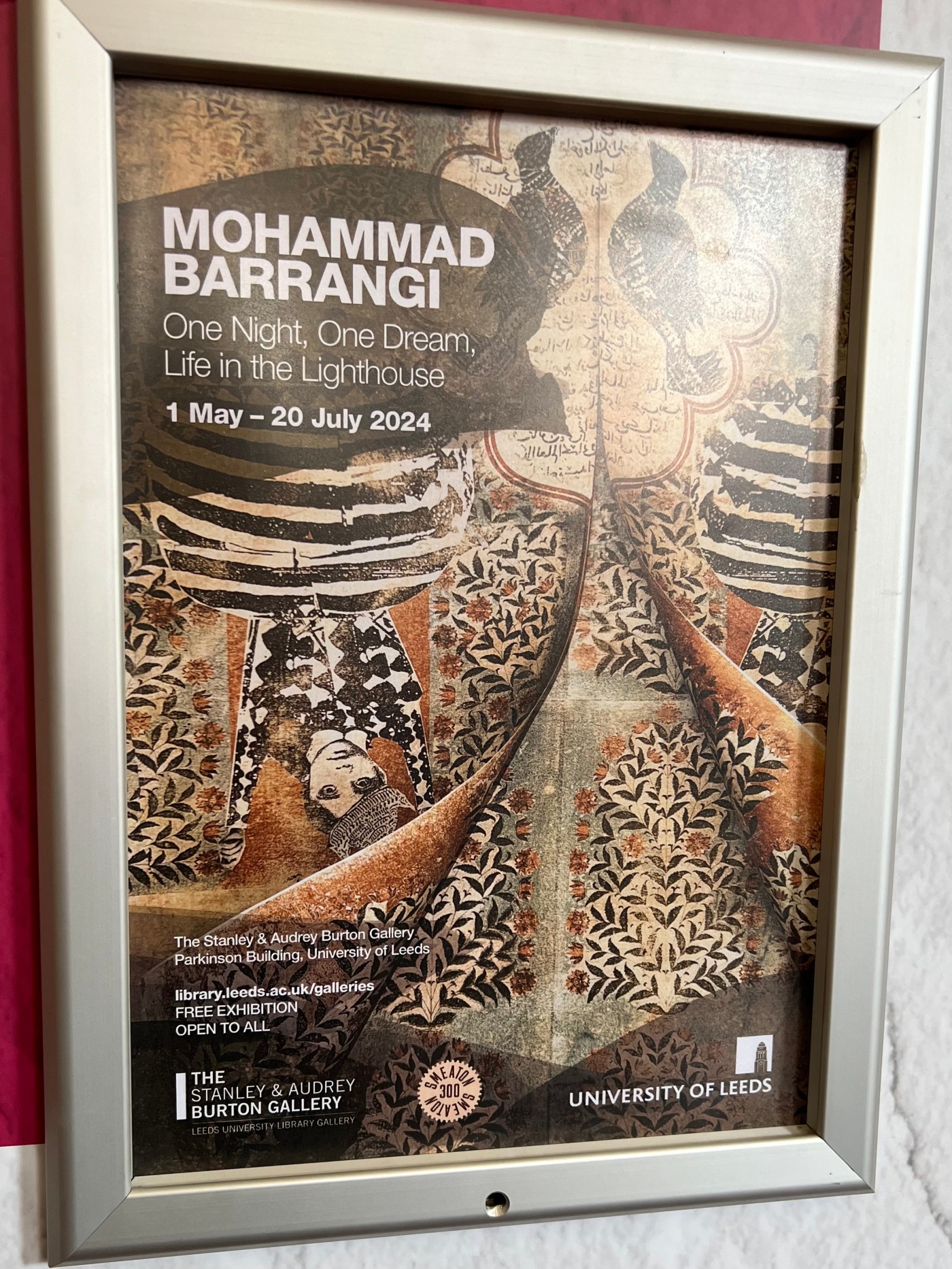
It is a couple of weeks since I went to this exhibition at the University of Leeds and in the interim it has attracted a lot of interest from experts in the field, not to mention enquiries from London museums. As I am still trying to come to terms with writing about art installations I feel vindicated in that, although it doesn’t speak to me on a deep level, I could appreciate the works and how they fitted into the narrative of the collection as a whole.
Mr Barrangi was born in Iran in 1988 and has studied in Leeds, his residency at the University’s Special Collections last year, meaning he was able to draw on – not literally – Middle Eastern textiles and manuscripts, Persian calligraphy and European scientific illustrations for his inspiration.
He also invokes his personal experiences of storytelling, Iranian mythology, folklore, biblical references, and British literature. The empowered female figures are inspired by his friends and family.
The exhibition centres around an exotic lighthouse, so it is relevant to Leeds in that this is the birthplace of John Smeaton (1724-1792), the UK’s first civil engineer, who contributed to the fields of navigation, astronomy and lighthouses, thus facilitating world travel.
In order to do the work justice I think that it would be best if I reproduce the artist’s own words of explanation.

Before reading the above synopsis I had a stroll round the room to form my own first impressions of the exhibits which, as usual, were far from the intended message. I took the centrepiece, which is what greets you, to be a temple rather than a lighthouse and the song ‘Stairway to Heaven’ immediately sprang to mind.

As I wandered round, the various articles of clothing and the large sketch on the wall slowly changed my mind, as did a unicorn peering from the base of the lighthouse, and the blue balls obviously represented the sea, so not easy access for worshippers. As soon as I read the explanation, all became clear.
I will include just a couple of exhibits as my photography doesn’t do them justice and they should really be witnessed first hand, or eye!

This is titled A Girl Dancing on her Hands and Another Offering Apples. You will see that the face is the same, seemingly superimposed onto the print. It is also the same image as is featured on the picture on the wall behind the lighthouse above.
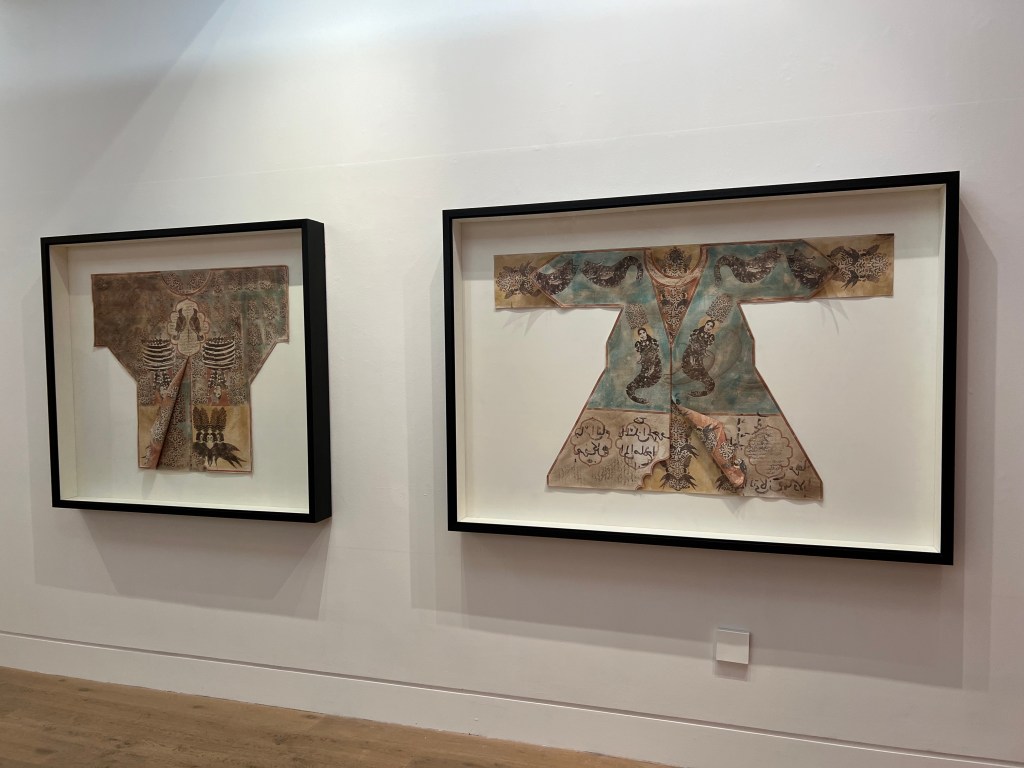
Here we have an example of the textiles on display, they are The Smell of a Woman’s Shirt 1 and 2. Once again the same face is present.
I was sorry not to have been able to go to the launch of the exhibition as it would have been interesting to hear what the artist had to say, and perhaps have had the opportunity for a chat, but it was not possible so I hope that I have whetted your appetite enough to make you want to go and see it for yourselves.
I have attempted to convey the artist’s intended message, but I recognise that I might not have done so as, in the words of the aforementioned song from Led Zeppelin, ‘There’s a sign on the wall, but she wants to be sure, ‘Cause you know sometimes words have two meanings.’
It makes me wonder.
One Night, One Dream, Life in the Lighthouse runs in The Stanley and Audrey Burton Gallery at the University of Leeds until 20th July, 2024. Opening times are Tuesday to Saturday 10.00am – 5.00pm except for 27th and 28th May when it is closed for the Bank Holiday. Admission is free and no booking is required.
To see what else is on offer at the venue please go to https://library.leeds.ac.uk/info/1900/galleries
Photographs by Stan Graham
 Tyke It To The Limit